Saturday, March 15, 2014

Spring Work Schedule

As we mentioned earlier, the weather has turned warm pretty early here in Idaho.  In fact we have had a string of fantastically sunny and warm days that are perfect for outdoor work.  And get to work we have.

Since one of the major goals of this season is to be more organized and proactive about the preparation and up-keep items of the homestead, we put together a list of jobs to get done in early, mid and late spring. Keeping on track, making sure elements of the homestead are squared way before the busy times of planting and tending start is a big deal that pays dividends throughout the season.

For example here is our early spring list, which is what we're working on now:


Early Spring (Now-April)
  • rake
  • churn up beds and compost
  • catch early weeds in bed, around beds
  • remove/cut down dead weed stalks
  • prune hedge away from beds & electric wires
  • prune berries
  • get chickens in back field to start on insects & goathead
  • eliminate grass in unwanted areas
  • fix irrigation trench in front to prevent flooding
  • Order seeds
 
A lot of these are aesthetic but we found last year that the cleanliness of the property, even if it does not necessary impact growing, makes a huge difference in how eager you are to work on homesteading chores.  Keeping an ordered homestead makes you feel better and keeps bugs and weeds down as well.

 
Even though it has been warm, in our area you have to be ready this early in the season for at least another week of cold weather, probably even in the 20s at night sometime before May.  So a lot of our real growing preparations are going to wait until April.  That is when we'll dig a new double-dug bed and start working on our field crop (which will be mostly clover). 

Only later in May will we start seeds inside and plant some cool weather plants outside.  But we'll get to that when it is time.  For now, it's still grunt work time. 

The raspberries after some intensive family labor pruning and getting rid of deadwood

Our sizable burn piles after pruning the hedge near the beds

Fruit tree leaves ready to be moved.  This area was used as a dog b-room too, so yay.

Tuesday, March 11, 2014

Coming Back to Life

And the blog is too!  Yes, it's been a few months since our last post since through the winter not too much was going on. It was not a bad winter over all.  We had a pretty cold December, the average temp for the month was about 22 and our coldest night was -11.  The last few weeks of January and the first half of February were quite snowy for our part of Idaho.  We probably got about 20 inches of snow in total. The last weeks in February and the beginning parts of March have been abnormally warm, with temps around 60 more than a few times and the nights not even getting below freezing. The best part of this warm spell was the rain, with Pacific storms sweeping all the way to us. As we have written in the past, southern Idaho has been in a severe drought for a few years, which impacted our season last year. The storms we have gotten have helped tremendously, both in terms of rain here and snow in the mountains.  Even though we are still in a moderate to severe drought in the valley, our water prospects look good from snow melt. The reservoirs are likely going to be near capacity for most of the water year and our well has been well charged by run-off coming underground from the surrounding highlands.

But all this warm weather means that spring work must begin.  Pruning, raking, preparing beds, weeding (already) and eventually planting are on the docket soon.  Our experience last year certainly showed that this grunt work is very important and can really set the stage for the whole growing season.  So, let's get to work!


Some of our producing but out-of-control raspberries that will be pruned soon.
Turning the beds over.  After winter the soil is still wonderfully loose. The strawberries and even some garlic (plus weeds) came back on their own.
We processed more chickens over the winter:  these are the high-producing remainder

A very luxurious chicken area
The reservoir 2 miles down the road is already full


Sunday, December 22, 2013

A Couple Winter Work Stories

Up until about 3 weeks ago when we had a week of sub-zero temps, our chickens were producing incredible quantities of eggs:  8-10 every day.  It's really quite amazing to have this product you spend real money for at the grocery store just keep coming and coming and coming with so little effort.  The chickens need food, water, shelter and to be cleaned up after and then dozens of eggs are there for the taking.  Remarkable provision that has been designed in to the world. 

At one point we had a subtle yet profound moment of connecting labor with produce.  We were grumbling about having to refill the chickens' water over and over until we realized that the water we provide is going in to the yokes and whites of the eggs we will be eating over the winter.  It's a "duh" moment in some ways, but also a small remarkable insight into how a farm works.

After the sub-zero week, the temperature has been much lower than previously.  The egg production has dropped off considerably:  now 2-3 eggs per day.  The chickens don't seem to like snow much;  they walk out into it to eat and drink the way a cat avoids getting its feet wet.  Also at one point when it was -10 degrees, a few of the chickens combs were frosted so that the tips got discolored and floppy.  It was unfortunate but the combs are healing and the chickens are still active and healthy.

Chickens are not sure about the snow...

Just SOME of the eggs we have.  Labeled with dates for storage.
As previously reported, one of the other elements of the homestead life we are working on is learning about and using natural and herbal remedies.  As part of this work we have made our first batch of tinctures.  Tinctures are super-concentrated doses of herbal extracts that are used to deliver potent medicinal properties quickly.  Tinctures may be, depending on the herb, taken by themselves (e.g., a few drops of Peppermint for an upset stomach) or may be mixed in order to target a group of symptoms (e.g. feverfew, valerian root and lavender for headaches).  On the relative scale of herbal potency, tinctures are more potent than infusions, which are themselves more potent than teas.   Tinctures are administered via dropper due to their strength and, though some herbs can be dropped directly onto the tongue, they are often added to hot water to dilute the taste and potency.  Tinctures of some herbs are so potent that care should be taken in making, administering and even handling them.

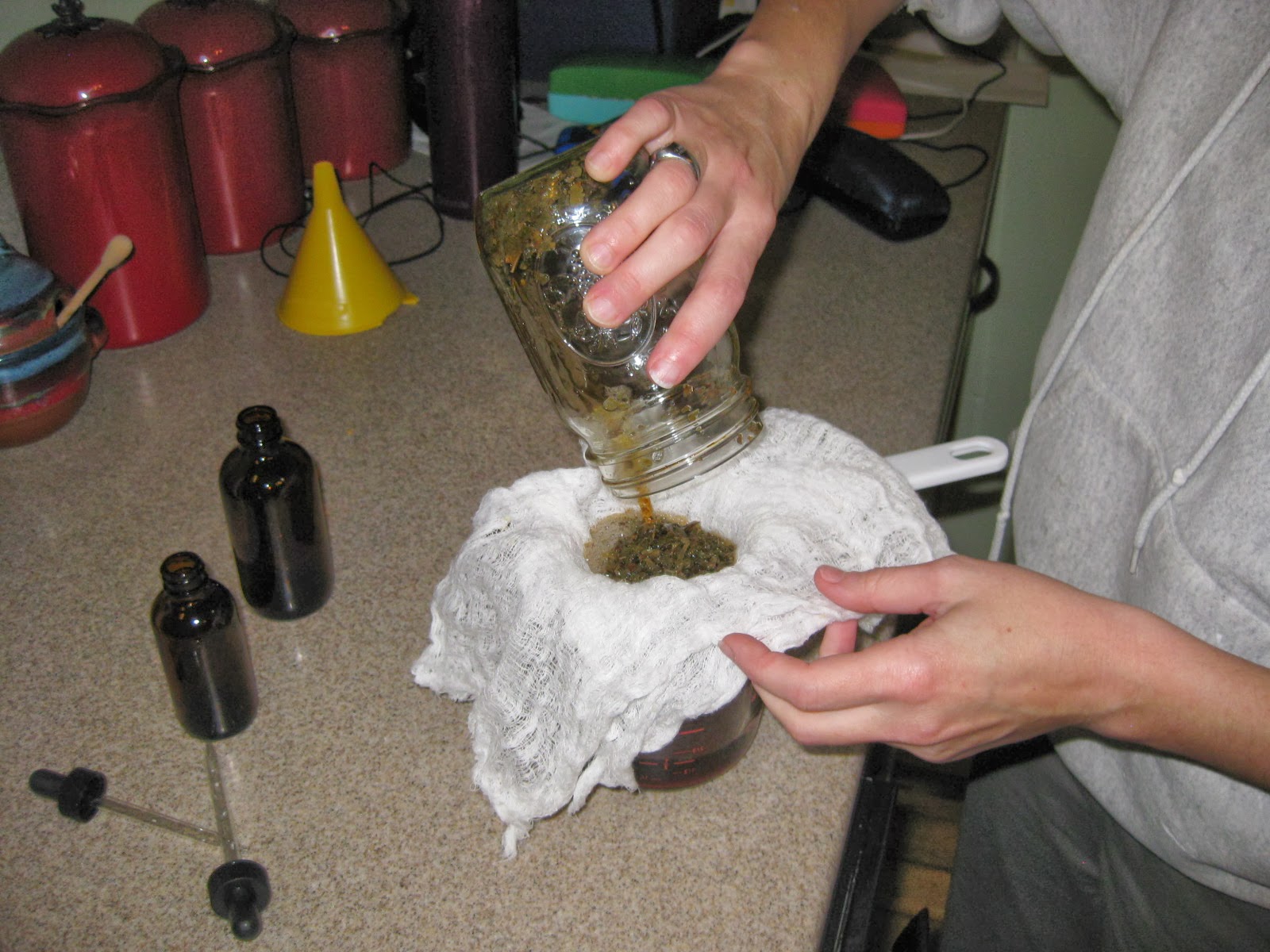
Tinctures are made by placing a quantity of herbs (dried or fresh depending on the herb) into a jar and adding a solvent.  In our case we used 80 proof vodka, although apple-cider vinegar can be used in order to avoid alcohol (though a tincture made from vinegar will not have as long of a shelf-life as one made from alcohol).  This mixture is then left to steep for 4-6 weeks in a sunny location, shaken daily.  As the pictures below illustrate, you then strain out the herbs in order to bottle the tincture.  Note that the remaining herb mush is so concentrated that you should take care, and do your homework, before placing them into a compost pit even if the herbs are organic (and you really should only make tinctures, or any herbal medicine, from organic herbs since you would be concentrating the pesticides from non-organic herbs and your tincture would then have little resemblance to medicine).  The herbal intensity and alcohol residue can kill the microbes in the compost.
Pouring and straining the steeped mixture

Squeezing out the tincture

Bottles should be either brown or cobalt glass to protect from sun damage

Tinctures are administered with a dropper.  Be sure to label well!

Wednesday, December 11, 2013

First Season Thoughts


It’s December: it is 20 degrees outside and the soil is frozen 2 inches down.  The first season of the homestead has come to an end.  In looking back on the first year it was over-all a successful year; especially for first-timers.  Our garden produced enough veggies to be used in multiple meals, our potatoes were prolific enough to provide dishes for months, our chicken meat will be available until at least the spring, and our hens are healthy and still laying a prodigious number of eggs.  It was a great achievement to serve our visiting family this October a meal completely grown on our property.  It wasn’t fancy but chard, potatoes and chicken is a hearty and super nutritious meal.

There are a few areas where we will be working to improve things next season.  As is always the case, learning comes with success and failure.  We’d like to mention a few of these areas.

Planning and organization:  For our first year we did pretty well identifying crops and varieties to grow, but some basic improvements will help a lot.  For one, some of our crops were just planted in the wrong season.  For example, the broccoli actually grew well but we planted it in mid –June, which meant it was maturing in the hottest part of the summer.  This made it unbelievably bitter, because broccoli is a cool weather veggie.  So, next time we’ll plant at appropriate times.  Also we didn’t space our crops very well in some cases.  All our lettuce came in at the same time so we had way more than we could eat and much of our lettuce crop went to the chickens once it was past its prime. With our climate we can grow multiple crops of lettuce, so timing again is important.  Finally, due to disorganization (laziness) some of the crops were not kept track of for future planning purposes. For example, we didn’t note which potatoes varieties we planted.  So for next year we don’t know which varieties did really well and which did not.  Obviously this is an easy fix but well worth making.  It’s the little things that make a difference.

Starting seeds:  This is one area we will really need to work on. This past spring we goofed on just about every aspect of starting.  First, we started our seeds too early so the seedlings were too mature when it was still cold out and could not be safety transferred outside.  Second, we struggled to find a good place to start the plants.  Our 100-year-old farm house does not have big sunny windows and it can get quite cool inside in the spring, which didn't help.  Finally we used cheapo soil which actively killed many of our seedlings.  This next spring we will be starting at appropriate times and are hoping to build a few cold-frames to help direct the warm sun on to the seedlings even when the temps are cool. As we found with the watermelon, starting properly is a big deal in Idaho where we have a relatively short growing season and wide day/night temperature swings.

Water:  As mentioned previously this past summer was literally the hottest summer ever in southwest Idaho.  So water was a huge deal.  Although we did pretty well with a combination of our water well and irrigation water, our water application was done simply with a hose.  This obviously worked OK but two big negatives presented themselves.  First was that the water falling from a height, even with low pressure, compacted the soil in our double-dug beds, partially negating both the work of digging and the function of the loose soil.  The other obvious negative was someone had to be there to water.  We are very much looking in to a simple drip system for next year.  These systems have many advantages.  They are inexpensive to set up, easy to operate (even automatically), most function on very low water pressure (~5 psi), they provide water directly to the root base and are up to 90% efficient in delivering water instead of wasting it do to evaporation and runoff.

Harvesting:  A surprisingly difficult aspect of growing is knowing when to harvest.  Reading books makes it seem that everyone has their own mysterious formula for knowing when to harvest certain plants.  For us this season it was basically trial and error.  "The tomato was red, so pick it" kind of thing.  This worked out over-all pretty well.  We did learn that okra needs to be harvested at a certain time or it's hard and fibrous.  We are not sure if we harvested the onions and garlic at the right time because they were small and have all gone moldy after just a few months.  The potatoes were done well however;  they were pretty large and healthy.  Harvesting again comes down to timing and when the planning and starting (see above) is done properly the proper harvest time should be more easy to discern. 

As the winter progresses we will continue to update on keeping chickens and bees over winter.  That will present their own challenges.  Also as we begin planning next year we'll keep the blog up-to-date with our goals, ideas and aspirations.

Saturday, November 16, 2013

Herbalism

      As we work towards a closer connection with the land, we are learning about incorporating more herbs into our diet, not only for culinary purposes but also medicinal ones. I am taking a Clinical Master Herbalist course and everyday learn more about the vast array of herbs available for common ailments and the various ways to prepare them. Currently, 30+ herbs are in our herb pantry for infusions, teas and decoctions. Our back porch is lined with tinctures soaking in the sun.


Some of our favorite simple teas/infusions:

Sleep helper:
1 part chamomile flowers
1 part peppermint leaf
2 parts passion flower

Awake and at 'em:
1 part ginger root
1 part cinnamon bark (chopped)


Tuesday, November 5, 2013

Potatoes!

Well, it goes without saying, but we planted quite a few potatoes here in Idaho.  We planted a couple of varieties but in a fit of disorganization we have no idea what they were or how to identify them!  Since they did indeed grow differently that was a mistake, but we'll try again.

We were pretty interested in how the potatoes would grow principally because we tried two different growing techniques we had heard about. First was we dug down pretty shallowly and then mounded dirt up over the green plant as it grew.  Since potatoes need loose soil to form the actual potato this is advantageous for the plant-at least as long as some green leaves are above the soil.  The second method was to dig down substantially deeper to plant the potatoes and then mound dirt up less high as it grew.  Of the two, the second method was by far better. We got healthier plants, more potatoes and it was much less work, both to cultivate and to harvest. Even though we got our "money's worth" in the number of potatoes, both methods are very high-labor and time-consuming, so we want to try a few other things next year to get production vs. labor to a more reasonable ratio.

But the potatoes are great:  very tasty and easy to store.  Along with the 7-8 eggs we are getting every day from our chickens, if we needed to, we could easy survive on just what we have grown ourselves.  Pretty cool.

Just some of the spuds.  Many have already been eaten and some are still in the ground.

Thursday, October 17, 2013

Later Fall Update

Since our last post fall has been progressing along.  The trees are changing color, the fields around us have been harvested of their corn, barley and sugar beets, and the weather has turned a bit wetter too.  One of the peculiarities of our location in Idaho is that at this time of year we get pretty remarkable temperature swings, leading to stress for our late season plants.  In the daytime we might be up in the mid-60s with warm sun but at night the temps will fall below freezing.  For awhile the warmth of the sun was still winning out but now it has turned and the chill is penetrating.

Our first sad casualty was our watermelon plant we wrote about previously.  It was going strong, with good-sized fruit that were growing everyday.  The plant did have to prioritize those fruit so the other little baby melons shriveled on the vine.  It all looked great and then this happened:
The cardboard with foil was an attempt to warm the melons sitting on top.

It is amazing how the frost really did burn the leaves.  Once the plant was clearly kaput we decided to harvest the melons since the plant would not be providing any more nutrients to the fruit.  Apparently it is not easy to ripen watermelons off the vine, but we are going to do our best.  The results will be posted soon.

Our crimson sweet watermelons
As with the watermelons the other plants in the garden have been suffering with the frost.  Our tomatoes are down for the season and it looks like our potatoes as well. However, the potatoes are looking good to harvest at this late point in the season.  We'll post about that too soon.
Frosted potatoes before harvest

All this is a good lesson in the importance of starting the plants inside in the spring.  Both the tomatoes and the watermelons were pretty short season varieties and they still ran out of time.  Maybe another two weeks of warmer weather and we would have had a huge harvest of tomatoes and good-sized watermelons.  Next year we will buy those few more weeks by doing the starting and transplanting right.